Settings
Open SETTINGS from the top bar, or from the main menu and the pause menu.
Two things apply everywhere: a row you have changed grows a small reset control, and Restore defaults resets the tab you are looking at — not the whole game.
- Resolution — the rendering resolution. Applies after a restart.
- Window mode — Maximized Window, Windowed Mode, Full-Screen, Borderless Window, or Borderless Full-Screen.
The game offers to restart for you when a change needs one.
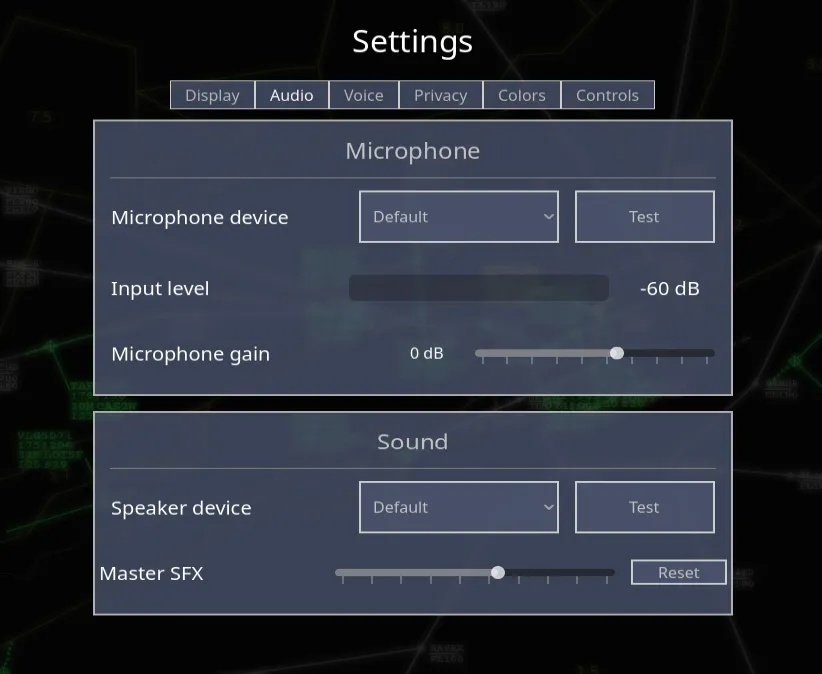
- Microphone — choose the input device.
- Input level — watch it move while you speak to confirm the game hears you.
- Test Audio — record and play back a microphone test.
- Microphone gain — boost or cut input volume.
- Speaker — the output every pilot voice uses.
- Master SFX — total game volume. Zero mutes deliberately.
Default (Windows app setting) follows whatever you assigned VoiceATC in the Windows Volume Mixer. Pick a named device to override that.
Speaker test.
Select Test to hear one pilot voice through the chosen speaker. A test cannot overlap another one; choosing a different speaker cancels the current test, so select Test again after changing devices.
If voice recognition is unreliable, this tab is the first place to look — a silent input-level meter means the game is not hearing you at all, which is a device problem rather than a phrasing problem.
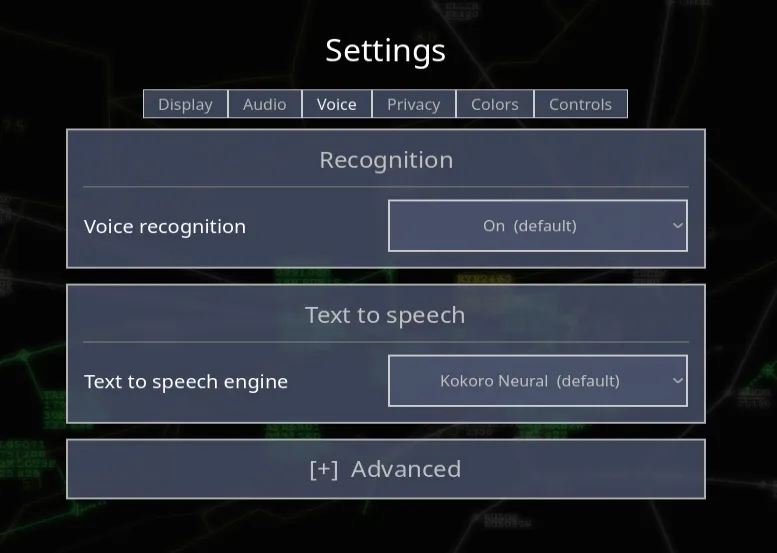
Closed beta Voice tab
Section titled “Closed beta Voice tab”Three cards keep everyday choices separate from troubleshooting:
- Voice recognition — on or off. Mouse commands stay available either way.
- Pilot voice — Automatic, Prefer Kokoro, or Prefer Windows. All choices use the speaker selected under Audio.
- Advanced — the voice check, then Speed (voice acceleration plus a Now using line naming the active hardware), Repair (Check for faster hardware), and three automatic engine rows.
The voice check shows two questions — Can the game hear you? and Can you hear the pilots? — each with the date it last passed, Never, or a short failure word. The one button below always names exactly what it will run next. The automatic engine rows read Okay when startup checks pass; they never mean Ready. Turning recognition off hides Speed, Repair, and the engine rows; saved checks are kept.
If the same voice problem repeats, the game shows one focused tip: check the microphone signal, run Check voice when recognition cannot decode a usable signal, or adjust push-to-talk timing. Isolated misses stay out of the way.
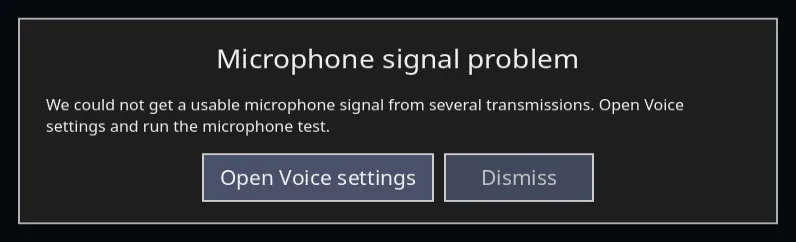
- Open Voice settings — go directly to the microphone and readiness checks.
- Dismiss — return to the session without changing voice settings.
Automatic microphone recovery. New in 0.6.1.26 The game repairs a known Windows audio pattern that can leave gaps in an otherwise valid recording. If Needs attention still reports microphone corruption, set the microphone and speaker to the same sample rate in Windows Sound settings — 48,000 Hz is a good choice — restart the game, then select Recheck.
| State | What to do |
|---|---|
| Off | Turn recognition on only if you want voice control. Saved checks remain. |
| Not checked | Select Check voice. |
| Finish check | Select the button — it names the missing part, for example Check the pilot voice. Only that part runs. |
| Recheck | The button names the changed microphone, speaker, or pilot voice; only that part reruns. |
| Ready | Nothing. Matching microphone, speaker and pilot-voice checks stay saved after restart. Check again reruns the full check if you want. |
| Needs attention | The failing question shows a short reason; the button retries that part. |
The first launch offers Check voice and Not now once for Not checked. Not now does not turn voice off. It prevents that prompt from returning.
- Start the recommended check. A first check covers the microphone and speaker.
- If asked, say “Speedbird four two one, descend flight level one zero zero.” The game uses the same recognition and command path as a session.
- If asked, listen for the pilot response. Select Yes, I heard it, No sound, Replay, or change the output.
- Select Done after Voice ready. The result updates immediately.
No sound opens route help without marking failure. Replay starts a fresh playback. If you still hear nothing, select Done to save that diagnosis.
Changing only the microphone repeats only speech. Changing the speaker or pilot voice repeats only playback. Driver, acceleration, and game updates do not erase successful checks. Turning recognition Off and On restores matching checks.
| Setting | Choices | What to use |
|---|---|---|
| Pilot voice engine | Automatic, Prefer Kokoro, Prefer Windows | Keep Automatic unless support asks you to test one engine. The preferred engine keeps working through ordinary delays; the other is used only if it errors or stops responding. |
| Voice acceleration | Automatic, Graphics card — faster, Processor only — slower | Keep Automatic. Forcing the graphics card still uses the processor safely if the Vulkan check fails — the Now using line shows which hardware is active. |
Voice acceleration uses Vulkan from your normal graphics driver. You do not need the CUDA Toolkit. Vulkan and CPU use the same recognition model, so only speed changes. Automatic compatibility checks happen during startup and do not repeat the guided microphone or speaker check.
Not in 0.6.1.24 The startup panel lists Navigation database, Pilot voice, Speech recognition, and Command understanding while it checks them. Graphics-card and processor choices appear only when the game needs to choose again; saved choices are reused.
When recognition is Off, startup skips its speech and Smart checks. Turning it On from the main menu runs the required speech check once. Turning it on during a session shows Voice starts next session.
Processor recognition leaves capacity for the simulator. After a short wait, the status shows Recognizing on your processor… with elapsed seconds. The complete command still uses the same model and vocabulary. Check voice also waits longer for processor results and remains cancelable.
When memory is tight, the game keeps speech recognition. It disables optional Smart understanding for that session and may use the Windows pilot voice. Your saved choices do not change.
A game update that changes this compatibility check reruns it once automatically. If Now using still says Processor only — slower after restart, press Check for faster hardware, then Run the check. Use this after a graphics driver update too. The page shows what it is checking while it runs, and a result message when it finishes. The simulator restarts only if the faster runtime changed.
Run it from the main menu. The check loads the voice models onto your graphics card, which a running session is already using; during a session the button answers with a reminder instead of running.
New in 0.6.2.0Each new or changed engine gets its own short, silent local check, and one slow engine cannot change another engine’s successful result. Matching results are reused on later starts. During session loading, the game names each active stage: Loading voice understanding…, Loading speech recognition…, and Loading pilot voices…. Basic voice can become available first.
Not in 0.6.1.24 Voice readiness now starts alongside navigation and traffic preparation instead of waiting for them to finish.
If you use Voicemeeter, compare the requested and actual devices shown by the check. Then inspect the VoiceATC route in Windows Volume Mixer and Voicemeeter. A routing problem does not mean Kokoro or Windows speech generation failed.
Not in 0.6.1.24Difficult commands now stop a slow understanding attempt promptly and move to a safe clarification instead of leaving voice control feeling frozen.
Diagnostic telemetry is optional and off until you agree to it. With consent, the game can send redacted command text and parser results so recognition problems can be diagnosed. Raw audio is never uploaded.
Diagnostics also cover flight behaviour: anonymous counts of how each flight you controlled ended, the airport, runway and procedures involved, your session settings and frame rate. Nothing that identifies you.
Not in 0.6.1.24Diagnostics can also count frame stutters and time a fixed list of game subsystems and functions. The game sends fixed labels and durations, not logs.
- Diagnostic telemetry — turn the redacted diagnostics on or off.
- Export voice diagnostics — creates a local ZIP with a disclosure README, a manifest, the latest redacted voice result, and safe hardware/capture facts. It makes no network request and excludes audio by default.
- Include latest failed clip — an optional second confirmation can add the one locally saved failed PTT and its decoder prompt to that ZIP. Speech may identify you; nothing is shared until you send the file yourself.
- Delete saved voice clip — removes the locally saved failed PTT and its private prompt immediately. The next genuine failed PTT replaces any earlier saved clip.
- Report a problem on Discord — opens community help.
- Privacy Policy — opens the current policy.
- Reset consent — returns consent to its first-run state and clears the local queue.
Ordinary game logs contain neither the recording nor its decoder prompt. A diagnostics-only export never contains them either.
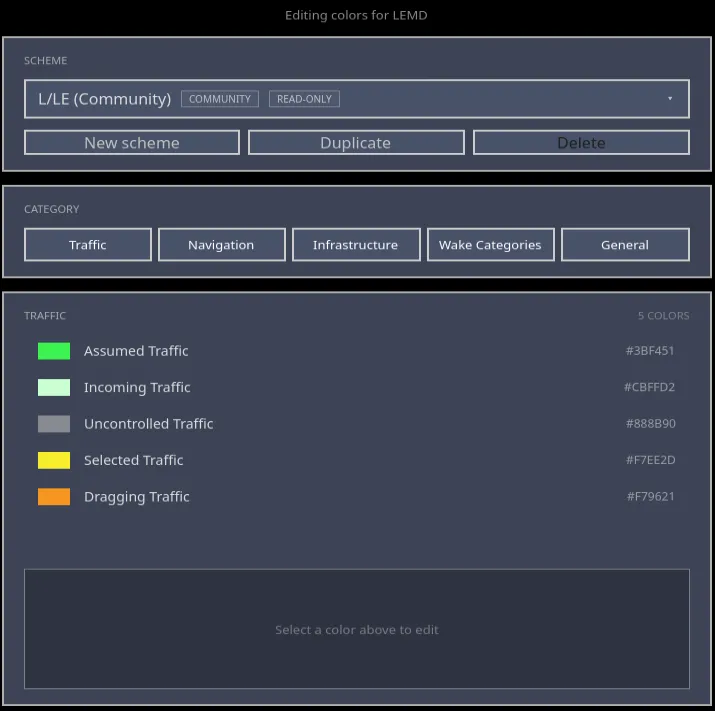
- Scheme list — create, duplicate or delete your own schemes.
- Category — which part of the radar you are recolouring.
- Editor — the colour itself.
You can bind a scheme to a specific airport, which is worth doing if you fly somewhere with a very different background or a lot of overlapping airspace.
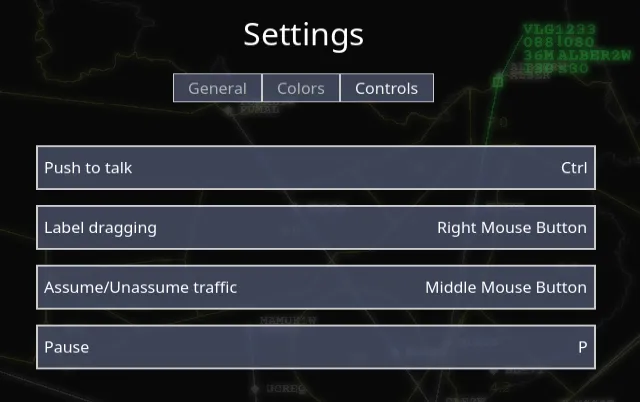
Every action with its current binding. Select a row to rebind it, including push-to-talk. Undo with the row’s own reset control, or Restore defaults for the whole tab.
The full default list is in Mouse and keys.